


Introduction
Thank you so much for requesting this guide which we sincerely hope will benefit you as you write video scripts and stories for your training programs.
“The storyteller sets the vision, values, and agenda of an entire generation that is to come” Steve Jobs

Why are we so passionate about storytelling?
Because it works, it makes training memorable, it uses emotional engagement to inspire learners to change, avoid mistakes and adopt new skills.
Stories appeal to all types of learners.
- Visual learners appreciate the mental pictures storytelling evokes.
- Auditory learners focus on the words and the storyteller’s voice.
- Kinaesthetic learners remember the emotional connections and feelings from the story.
Here are the opinions of some of the world’s greatest storytellers that highlight the power of storytelling:
“Good stories do more than create a sense of connection. They build familiarity and trust and allow the listener to enter the story where they are, making them more open to learning. Good stories can contain multiple meanings so they’re surprisingly economical in conveying complex ideas in graspable ways.” –Vanessa Boris, Harvard Business Publishing Corporate Learning,
“Your goal in every communication is to influence your target audience (change their current attitudes, belief, knowledge, and behaviour). Information alone rarely changes any of these. Research confirms that well-designed stories are the most effective vehicle for exerting influence.” Kendall Haven, Author of Story Proof and Story Smart
“Storytelling is the most powerful way to put ideas into the world.” Robert McKee, Story Mentor
“Stories are memory aids, instruction manuals and moral compasses.” Aleks Krotoski, Author, Broadcaster, Journalist and Social Psychologist
“Stories are our primary tools of learning and teaching, the repositories of our lore and legends. They bring order into our confusing world. Think about how many times a day you use stories to pass along data, insights, memories or common-sense advice.” Edward Miller, Illustrator and Product Designer
Storytelling is so powerful that it can have a lifelong influence on those that view your training videos, even to the extent of changing their values and goals.
As I teach video production skills, I tell stories about the time:
- I was kidnapped on a shoot in Chile as soon as I arrived at the airport.
- I was chased by a gang of knife-wielding locals through the streets of Panama and rescued by a school bus.
- I was embarrassed by disasters on film locations, like the time I set off the sprinkler in an open plan City office by placing a faulty light beneath a smoke detector.
- I unwittingly initiated an armed robbery in a chemist shop in Exeter.
- I nearly died on a mountain road rushing from a shoot in Northern Hungary to an airport in Vienna.
- I foolishly chose a filming location for a major shoot that turned out to be directly beneath the flight path of London City Airport
- I received invaluable scripting advice from Doctor Who in a London recording studio.
All my students remember these stories, andt as they recall them and ponder on them, they will remember the important principles each story taught.
Let me remind you of the Native Indian proverb, “Tell me a fact and I’ll learn. Tell me the truth and I’ll believe. But tell me a story and it will live in my heart forever.”
I want my training to live in my students’ hearts forever. I want them to live these experiences with me, feel the emotions I felt, learn the lessons I leaned and, hopefully, become a better videographer as a result.
Training videos need to be authentic and relatable
We need our learners to relate to the characters in our training videos, so these characters need to be real, authentic and likeable people who have flaws like them, and are facing the same real-life challenges that they are.
“I think the best stories always end up being about the people rather than the event, which is to say character-driven.” Stephen King
In your training videos, you need to show how your characters overcome these challenges, and you need your learners to care about them so much that they are routing for them to succeed as their stories unfold.
Finally, when these challenges are resolved, our learners should be inspired by them and desire the same outcomes for themselves.
So, make your antagonist (your hero), as close to your target audience as you can, so that they see themselves in the character.
We often create characters who are larger than life, who make the most absurd mistakes to get a laugh – like John Cleese in the old Video Arts videos, but we cannot truly relate to these individuals as they are just caricatures – not real people.
Such comedy does have its place, but it requires seasoned actors with big personalities and comic timing, who may not be available to you. What’s more, these videos are used more to show people how NOT to do things, rather than how to do them well.
You need to create a hero who is authentic and makes mistakes. It is their problems and faults that makes them human, and therefore likeable.
The fact of storytelling hints at human imperfection. Where there is perfection there is no story to tell.” Ben Okri, poet and novelist
Most detectives on TV now are no longer upstanding champions of morality and justice. They have deep flaws: marriage problems; addictions; evil intentions; or mental disorders. We watch them battle to overcome their demons as well as solve the crimes. Their character arc (transformation) is the real story that makes the show watchable and engaging, not the unfolding of the investigation.
Likewise, your hero’s journey should not be straight forward. They may not, at first, recognise that they have a problem, a weakness or a need to change. They might be reluctant to learn, even opposed, but we will watch him overcome their concerns, doubts and fears, we will watch them recognise their weaknesses and come to a realisation that they would benefit from change. As we observe their change of heart, our hearts are changed too.
Our learners find themselves walking beside our heroes, willing them to reach their goals and find a happier and better place. We will learn from these characters as they learn, and we will remember the story and how it made us feel.
Casting
To ensure authentic performances from your cast, consider using talent that may exist within your own organisation, who have experienced first-hand, and felt the emotion of the story you are telling. In fact, your employees may be the best source of the inspirational stories! Ask them about their career and life journeys, the challenges and obstacles they have had to overcome, the lessons they have learned, and the skills they have needed to obtain.
If you decide to cast an actor, ask for someone who has experience in your industry so they can also be as authentic in their performance as possible.
You can use websites like starnow.com or backstage.com to reach out directly to actors and specify exactly what you are looking for. You can even ask them to provide a self-tape of them delivering your lines, which they will record on their smartphone, to make sure they do so in a believable, authentic manner. When you have selected your shortlist, you can also audition them over Zoom, Teams or Facetime.
Where do these stories come from?
It is not necessary to always make up stories. As we have already mentioned your employees will have had personal experiences that relate to the skills that you are teaching, but so will senior management, industry peers, customers and yourself!
When you have decided on the key points you want to teach, ask them about their own related stories. You can then choose the one that fits the training best or combine elements from each.
You will find other inspirational stories in industry publications, news reports, social media feeds, discussion groups or even chats by the coffee machine that can form the backbone for your videos. These may not be relevant for your current project but if you record them, you may be able to use them in the future.
Metthew Dicks, one on the world’s finest storytellers recommends that you keep a spreadsheet and add to it a story idea every single day from something you have read, seen or heard. He calls this Homework for Life. You’ll then be focussed on looking for storylines continually and you will end the year with literally hundreds of ideas, but you must be consistent.
“Miss one day, and you’ll allow yourself to miss two. Miss two days, and you’ll skip a week. Skip a week and you’re no longer doing your Homework for Life.”
Matthew Dicks
I would suggest than you have a “topic” column in your spreadsheet so that you can sort the ideas into relevant groupings.
What makes a great story?
Create a story that will move your audience. Ensure it tells the emotional journey not just the factual one. Make sure the audience feels that moment of transformation in the life of your protagonist.
“Seek out the moments when you felt your heart move. When something changed forever, even if that moment seems minuscule compared to the rest of the story. That will be your five-second moment. Until you have it, you don’t have a story. When you find it, you’re ready to begin crafting your story.” Matthew Dicks
There are many ways to structure a story and in this brief document we will only have time to examine a few. You can discover many more, and develop your stories, on our Storytelling and Video Production Masterclasses, but let’s start here with the classic Hero’s journey.
Most TV series and movies you watch are the transformative story of a hero or anti-hero.
- Luke’s transformation into a Jedi knight.
- Indiana Jones’s transformation from a treasure hunting sceptic to a believer in the supernatural.
- Dr Alan Grant’s transformation from child hater to loving protector in Jurassic Park.
- Peter Parker’s transformation from geeky kid to the Amazing Spider-Man
- Or even the psychological decline of Arthur Fleck as he transforms into The Joker
“The most amazing thing for me is that every person who sees a movie brings a whole set of unique experiences, but through careful manipulation and good storytelling, you can get everybody to clap at the same time, laugh at the same time, and be afraid at the same time.” Steven Spielberg, Filmmaker
We remember these movies because they are great stories, and we watch them repeatedly, remembering every detail and sometimes, in the case of the greatest fans, we can quote them word for word. This is the power of a great story.
To be effective a training video must be memorable. For a training video to be memorable it must tell a story.
We have been trained in the movies
The best movies often have a training element – we can learn from them, and we are changed by them. We may become more compassionate, more determined, more ambitious or be inspired to change careers or attitudes.
- The Pursuit of Happyness – How to go from homelessness to achieving your dreams.
- Erin Brockovich – How resourcefulness can allow a single mum to fight and beat a major corporation in court.
- Forest Gump – How the optimism and resilience of a simple man can inspire a generation.
- Good Will Hunting – How even a troubled youth can learn to embrace his potential.
- Rocky – How determination and hard work turns a back street brawler into a world champion boxer.
I bought the Rocky boxset and watched them many times with my wife and four children, and I firmly believe that those films and other inspirational movies, had a huge impact on us all and trained my sons and daughters to rise in their respective fields.
When I visited Manhattan recently to see my youngest son, who now lives there, we made a point of visiting Philly and running up the steps to the Philadelphia Museum of Art, as Rocky had done (well I walked up, my son and wife ran!).
We all felt the same surge of adrenaline as we did when we watched the movie, especially as an Afro-American busker in a tracksuit was playing the Rocky theme enthusiastically on his trumpet.
What impact these great stories have on our lives!
Of course, we have neither the time nor the money to create such movies for tra8ining purposes, but we can tell a transformative hero’s journey in a training video that is just a few minutes long.

The 12 Step Hero’s journey
Here is the full 12-step hero’s journey credited to Joseph Campbell in his book “The Hero with a Thousand Faces” (1949)
- The Ordinary World – Introduce hero as normal, relatable individual.
- Call to Adventure – Moved out of their comfort zone.
- Refusal of the call – Nah, I don’t think so.
- Meeting the mentor – Who gives them the tools to succeed.
- Crossing the threshold – Stepping out into the new world.
- Test, Allies and Enemies – Intro to obstacles, protagonists and supporting cast.
- Approaching the climax of danger.
- The Ordeal – The Life or Death Moment – Will they succeed or fail.
- The Reward – They have overcome the obstacle and gained the reward.
- The Road back – Discovering the consequence of what they have done.
- Resurrection – The protagonist returns for the final Climax.
- Return – Hero returns home transformed by their adventure.
There needs to be high stakes involved
There needs to be some kind of transformation.
For or details visit https://www.grammarly.com/blog/literarydevices/heros-journey/
The Three-act Structure
The three-act structure probably lends itself better for shorter training videos.
Set-Up, Confrontation and Resolution.
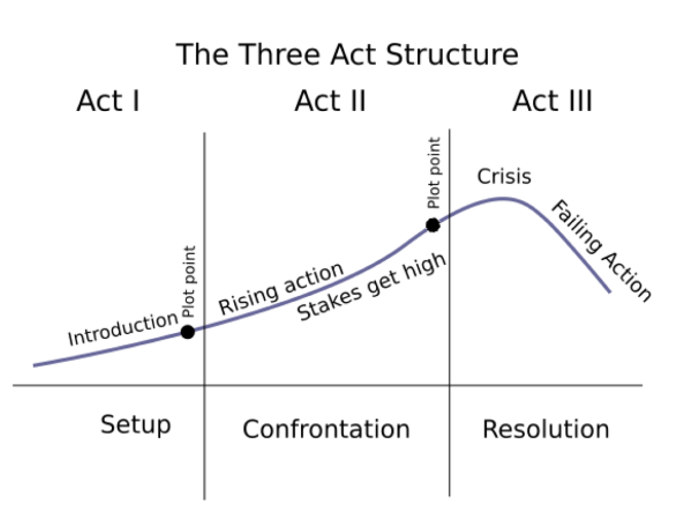
Act One – Set Up
Introduce your character and show their strengths, their faults and circumstances. This can be done visually, with or without dialogue. Give the audience a reason to like and empathise with your main character. End this act with an event that will set him on his transformational journey. A problem to be solved or a quest to be achieved. The learning objective.
Act Two – Confrontation
Introduce conflict, obstacles and challenges. Give him allies (or a mentor) to support
and guide him and, if relevant, introduce a protagonist to oppose him.
End the act with a major setback and set the scene for your story’s climax.
Act Three – The Resolution
The story intensifies and reaches a peak of conflict where the challenge or major
obstacle is faced and eventually overcome. Finally, the hero is changed by these events and embraces what they have learned.
Imagine how your learning objectives can be achieved by using this story framework.
Applying the Three Act Structure to Training Videos
It is true that storytelling is not suitable for every type of training video, but when it does, here is the recommended Three Act Structure.
ACT ONE – THE SETUP
Scene 1 – The Problem (Meet Antagonist and Identify the Business Problem)
Scene 2 – The Impact (What are the Consequences/Effects of that Problem)
ACT TWO – ACHIEVING THE SOLUTION
Scene 3 – The Idea (Lightbulb Moment – Spotting an opportunity or Solution)
Scene 4 – Implementation (Overcoming Obstacles and Implementing the Solution)
ACT THREE – THE RESOLUTION
Scene 5 – The Result (Show the Benefits to Individual and/or Company)
Scene 6 – Success (Long-term Value, Personal Transformation and Call to Action)
Try out this formula with any topic you need to provide training on. It works incredibly well.
Formulating your story
To create your story, first ask yourself:
- Who is the training aimed at: that’s your hero.(The Antagonist)
- What challenges and problems are they currently (The Need for the Training).
- What and who will stand in their way to gaining these new skills. (The Protagonist)
- Who can help him to learn these new skills (The Mentor)
- What is the major obstacle and how can that be overcome? (The Obstacles)
- How can the challenges to overcome (The Training)
- What difference will it make to the hero’s life now they have obtained these skills? (The Reward)
How to integrate storytelling into training programmes
Here are some useful tips when using storytelling for training.
- Identify common workplace challenges by interviewing employees/clients.
- Focus on specific problems learners are likely to encounter and challenges that align with learning objectives.
- Feature relatable characters facing challenges. These elements drive the narrative Ensure your stories resonate with diverse learnersby incorporating characters and settings that reflect your workforce/client’s demographics.
- Balance storytelling with time constraints: Short stories or micro-narratives can be just as effective as longer ones, especially when paired with visual elements.
- Avoid overly complex plots: Keep narratives simple and focused on one or two core lessons to avoid overwhelming learners.
The Pixar Pitch
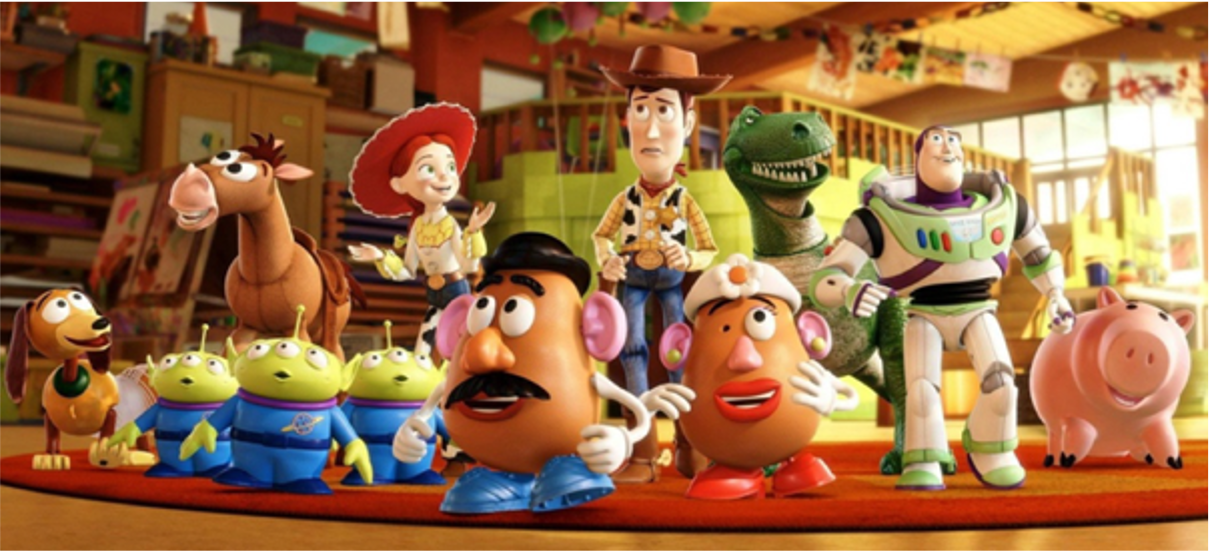
Another storytelling structure, devised by the makers of the incredibly emotionally engaging Pixar movies like Toy Story, Finding Nemo and Cars, is very simple.
Of course, when it comes to storytelling, few do it better than Pixar. They are experts at crafting engaging, touching, emotional narratives.
This simple, yet powerful framework has been a cornerstone of Pixar’s storytelling success.
This method captivates audiences and ensures every story has a clear, engaging structure.
- Once upon a time, there was a … Begin by introducing your main character in a way that captures the viewer’s attention.
- Every day… Establish the current reality or routine. This helps the audience connect with the story by relating to familiar experiences. Highlight a challenge they face on a day-to-day basis and its consequences creating a strong emotional bond.
- One day… Introduce the catalyst for change. This is the moment where something happens that disrupts the status quo. This is where you introduce your training solution.
- Because of that… Show how this training impacts the character’s life.
- Because of that … Continue escalating the advantages of the training by showing additional positive outcomes or unexpected benefits.
- Until finally… Conclude by showing how the training has transformed the character’s life for the better. End with a strong call to action, inviting viewers to act upon the training principles that you have shared.
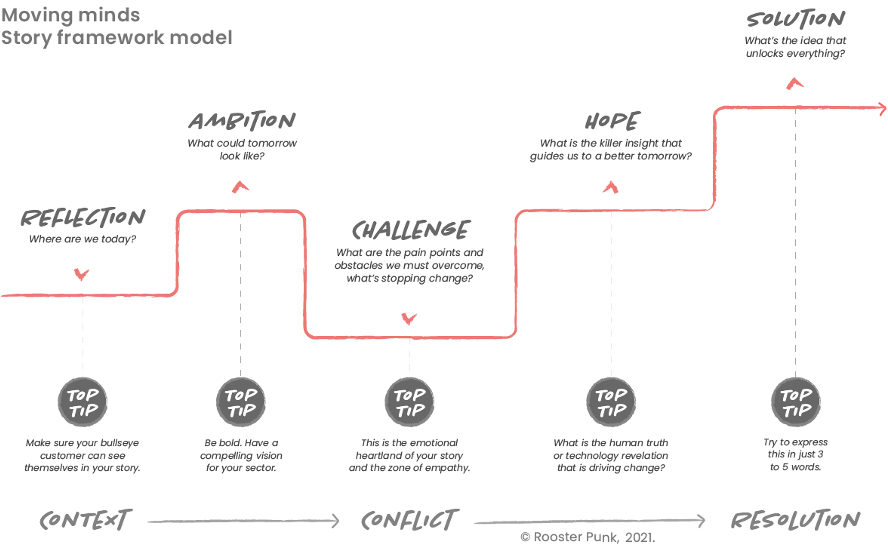
Moving Minds
Here is a variation of the Three Act Structure that has been designed to help to change people’s mind sets, that I recently found on LinkedIn. Sorry, I did not make a note of the contributor!
Open with a powerful hook
Now we have a story, how do we get the learners attention?
In the current “swipe” culture we have approximately 2.7 seconds to get someone’s attention before they move on to the next video, so we must start our videos with a hook that will compel the viewer to watch our entire video.
You should gain their attention with curiosity and intrigue. Start with the most dramatic or compelling part of the story, often the lowest point in the hero’s journey or at the point of a setback or confrontation.
Take note of how a TV program or films managed to grab you in the first few minutes with a chase, the discovery of a dead body, the mysterious or threatening phone call, the stalker looking through the window, the explosion, the gun shot, the frightened face, the desperate search for a loved one, the mysterious noise when alone in the house, the list goes on but the result is the same… we want to see more.
Leave the viewer wanting to know how and why your hero is in that position, and wondering how they will overcome the challenge they are facing. Then bring them
back to the present and lead them up to that point. Often including some misdirection (a twist) so things are not always as they first seemed. After all, we don’t want to give everything away in the first scene, do we?
For example, an educational institution started their video on “The importance of taking studies seriously” with a plane crash in bad weather conditions (stock footage) and a tsunami crashing a shoreline (also stock footage).
The video went on to show that the plane crash was caused by a belligerent student pilot who had cheated in his aviation exam by writing answers on his hand and never learned properly how to fly in bad weather conditions. The training video contrasted that with a young girl who had conscientiously learned about Tsunamis at school. She recognised the signs when the tide suddenly rushed out, and managed to clear the beach, saving hundreds of lives, before the wave came crashing in.
A powerful, emotionally engaging and memorable video.
The hook doesn’t always have to be dramatic, sometimes it can be as simple as:
- A shocking statistic or fact
- A poignant question
- An understanding of the viewers challenges
- The establishment of common ground, or
- A promised outcome
- An intriguing promise
Elements of a successful hook
The four elements of a successful hook are:
- The Visual Image (Footage)
- The Caption
- The Voice
- The Music/Sound Effects
Consider how you can combine these elements to make an immediate impact. Research has shown that the Caption is the most important element as this is what the viewer sees first.
All these hooks and story structures are covered in our courses along with
storyboarding and production skills.
End your video with a clear summary and call to action
As we have mentioned time and time again, a great story is memorable and can stay in your learner’s hearts and minds forever, but they also need them to act upon it as soon as possible, so no single element of our training is lost.
So, as soon as you finish telling them the story, tell them why you told them the story, give them something to do IMMEDIATELY that will enable them to put their
newly discovered skills into action.
This could be starting a major project or doing something as simple as:
- Going to another touchpoint where they can learn more
- Sharing what they have learned with a colleague
- Writing a summary
- Taking a short test
- Undertaking a task that will utilise the new skill
- Reviewing the video
Well, that’s it for now. Thank you for taking the time to read this article. We really hope that you have found it useful and we’d really like to continue to help you on the road to Video Mastery
Get regular video production tips
I very much hope that you have found this guide helpful, if you would like to receive
regular tips please subscribe to the Video Mastery Tips newsletter by clicking on this
link. https://mailchi.mp/videomastery/tips
Learn how to develop your storytelling skills and produce broadcast quality training videos in-house
At Video Mastery we’ll show you, not just how to write a compelling story, but how to
bring your story to life.
Our 3-day Video Production Masterclass for Trainers, is held at your premises, tailored to your exact needs and presented by highly experienced UK producers.
The course has been developed specifically for L&D professional and covers every aspect of Training Video Production including: pre-production; scripting; storyboarding; the art of storytelling; choosing a location; casting; interviewing skills; smartphone or camera operation; filming techniques; composition; shot angles, sizes and movements; lighting design; quality sound recording; use of gimbals; greenscreen; and editing skills. Everything you need to know to create professional videos.
Here’s an overview of the course: https://videomastery.co.uk/mc004-video-production-masterclass-for-trainers/
We can even work on one of your training video projects during the course which ends with a premier, popcorn and, of course, a Video Mastery Oscars ceremony!
After the three days your training teams will be transformed into professional videographers capable of creating effective and engaging training videos of cinematic quality.
Our Credentials
All our trainers are highly experienced video producers, all with at least two decades of experience. Video Mastery has been rated “Excellent” on Trustpilot. Our courses are also CPD Accredited.


You can find out how L&D professionals are benefitting from our training courses by looking at some recent testimonials. https://videomastery.co.uk/testimonials/
Or downloading our case study brochure https://videomastery.co.uk/videomastery-guide/
Always willing to offer help and advice
I very much hope to be able to come and train your team sometime in the future,
Meanwhile, I’m always available to give help and advice. You can contact me using any of the details below.
This article was written by Peter Middleton, Managing Director of Video Mastery Ltd
Email: peter@videomastery.co.uk
UK Website: VideoMastery.co.uk
US Website: VideoMastery.us
LinkedIn: linkedin.com/in/petermiddleton
Mobile: 07885 468674
If you’d like to book some training or just get help with any aspect of video production just book a Zoom call with me here: